Top Signs You Need Garage Door Service – Don’t Ignore These
A garage door that takes two seconds longer to open than it did last month isn’t aging gracefully. It’s a motor working harder to compensate for a friction problem that’s about to get expensive. The clearest signs you need garage door service are uneven movement, grinding or popping sounds, a door that reverses before closing, and cables or rollers that look frayed from the ground. Catch any of them early and you’re usually looking at a small repair, not a full rebuild. If you’d rather not climb a ladder to diagnose it yourself, call (833) 382-8894.
What are the most common signs a garage door needs service?
Most garage door failures announce themselves well before anything snaps. In our experience, the problem is that homeowners read those signals as minor annoyances, a little noise here, a slower open there, rather than mechanical wear. By the time a door stops working entirely, the damage has usually moved from one part to several. Here are the signs worth taking seriously in Joliet:
- Uneven movement. One side lags or drops faster than the other. This is the single most urgent warning sign.
- New noise. Grinding, popping, or a skip in the track that wasn’t there a month ago.
- A door that reverses before it closes. Usually a sensor or seal issue, not the opener.
- Visible cable wear. Fraying, kinks, or slack that looks different on one side than the other.
- The door won’t stay up on its own. A balance problem that points straight at spring wear.
- The opener strains or hesitates. The door runs but the motor sounds like it’s working overtime.
One sign on its own can be nothing. Two together, especially uneven movement paired with new noise, is your cue to get it looked at. That’s the difference between a cable replacement and a panel repair, and it’s the whole reason this list exists.
What do the sounds actually mean?
The sound a struggling door makes tells you a lot about which part is failing. Homeowners often describe them the same way, “it’s just noisy,” but mechanically they’re distinct, and each points at a different fix. Learning to tell them apart helps you describe the problem accurately when you call, which saves time on the diagnosis.
- Grinding usually means metal-on-metal friction: dry or worn rollers, a bent track, or a torsion assembly under load. It tends to build gradually and gets louder under the weight of a heavier door.
- Popping often signals a cable slipping in its drum or a roller jumping the track. A single pop at one spot in the travel is a classic sign the door is catching on something.
- Skipping or stuttering as the door moves points toward the opener’s gear, a failing motor capacitor, or a chain or belt that’s out of adjustment.
- A sharp bang followed by silence is the sound of a torsion spring letting go. Stop using the door and call for emergency service.
If your door has started grinding in Joliet, don’t wait for the sound to resolve on its own. It rarely does. Most of these issues are straightforward to address once the part is identified, but ignoring them wears out the opener and the panels along with the original problem.
Why is uneven movement the warning sign you shouldn’t ignore?
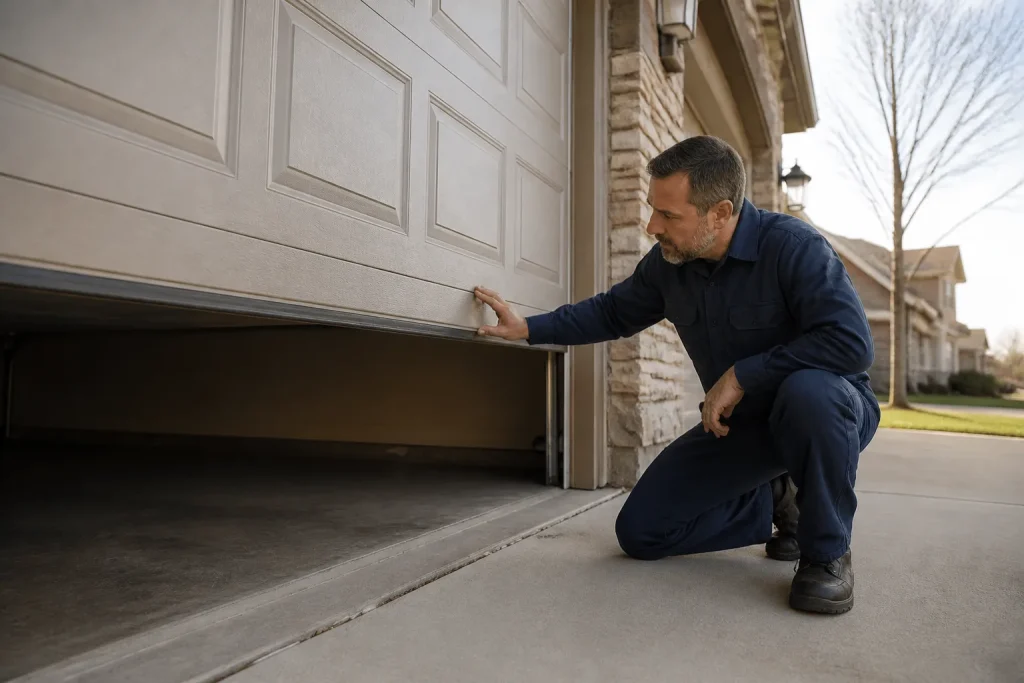
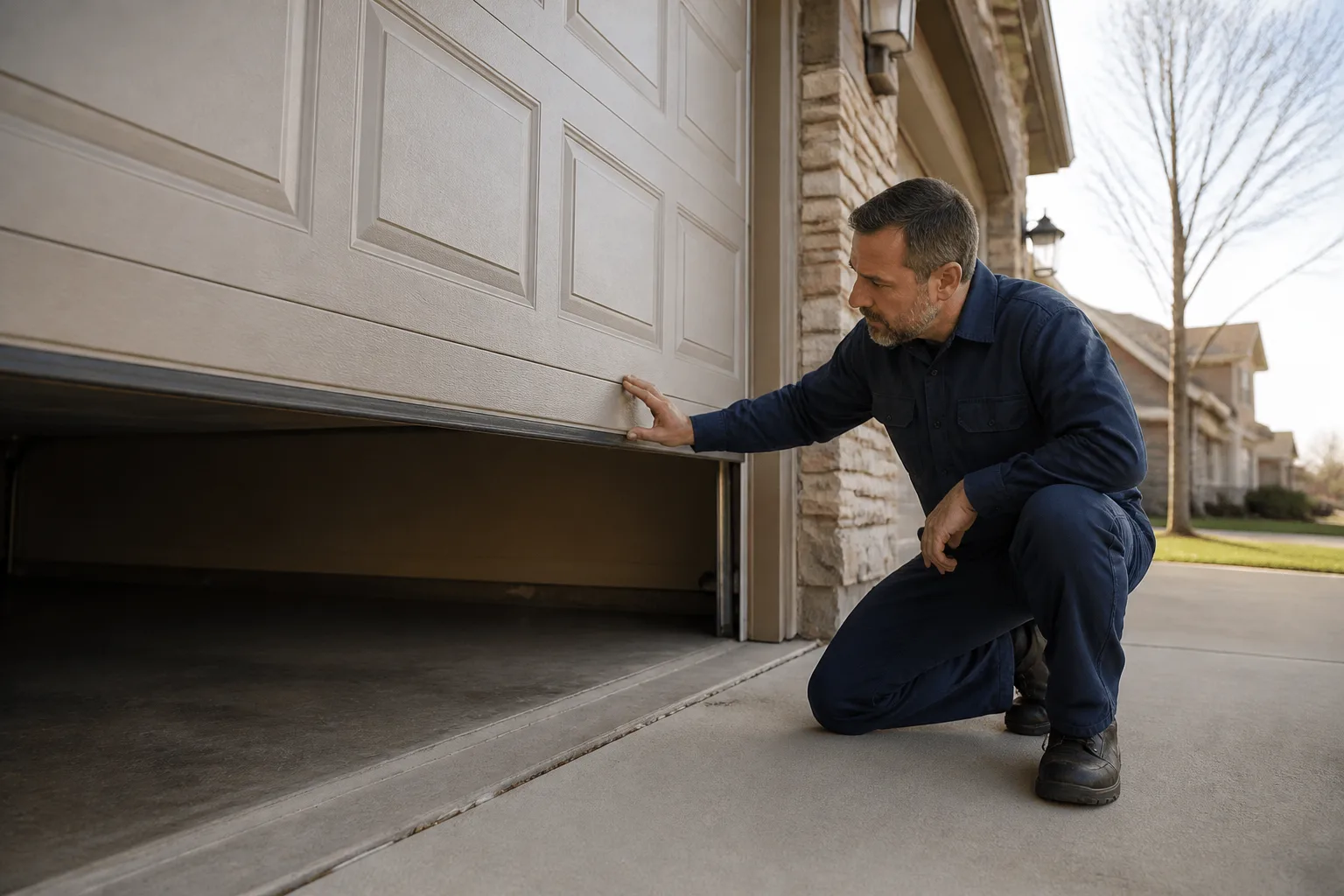
Uneven movement is the most urgent sign a garage door needs service because it usually means a torsion spring or cable has lost tension on one side. That imbalance throws extra weight onto the opener and twists the panels as the door travels. Left alone, it turns a manageable spring or cable repair into bent panels, a cracked section, or a door that’s off track entirely.
You can spot it without tools. Stand back and watch the gap between the bottom of the door and the floor as it rises. If one corner lifts noticeably ahead of the other, or the door visibly tilts as it goes up, that’s your signal. The same goes for a door that looks level when closed but wobbles side to side on the way up.
The reason it matters so much in Joliet is the weather swing. Freeze-thaw cycles work on the metal and the seal, and a door that’s been fighting friction all winter tends to show its imbalance the moment the temperature jumps. Catching it early is the difference between replacing one worn part and repairing panels that bent under the strain. When your garage door is the problem, it’s the only problem, which is why we treat uneven movement as a call-sooner-than-later situation.
How do you do a 30-second balance test?
A balance test reveals spring wear before the spring actually breaks, and you can do it in about thirty seconds with no tools at all. It’s the most useful thing a homeowner can check, and almost nobody does it.
- Disconnect the opener. Pull the release handle so the door moves by hand, not by motor.
- Raise the door to about waist height. Lift it about halfway up, slowly.
- Let go and watch. A healthy door stays put where you left it. If it drifts down, the springs have lost tension. If it drifts up, they’re over-tensioned.
- Lower it back down fully. Reconnect the opener when you’re done.
A door that sags more than a few inches in either direction is telling you the springs are out of balance. That doesn’t always mean replacement, but it does mean the assembly is working harder than it should. The balance test won’t tell you which part is worn, but it will tell you whether the door is under proper tension at all. If it fails, that’s your signal to stop forcing it and get it checked.
Safety note: torsion springs and cables are under extreme tension and can cause serious injury, so leave any adjustment or replacement to a trained technician. The balance test is safe to do by hand; working on the springs is not a do-it-yourself job.
What can you see on cables and rollers from the ground?
You can learn a lot about a door’s health just by looking up at it from the ground, no ladder needed. The trick is knowing what “worn but serviceable” looks like versus “replace now.” Both can look fine from a distance, so it helps to know the difference.
- Cables: A little surface rust is normal. Fraying, bird-caging (where strands separate and unwind), or one cable noticeably slacker than the other is a replace-now situation. Never touch a slack or frayed cable; call a professional.
- Rollers: Steel rollers that still spin freely and sit square in the track are fine. Rollers with flat spots, visible cracks, or a wobble are on their way out and will start grinding soon.
- Hinges and brackets: Light surface rust or a bit of wear is serviceable. Loose, bent, or cracked hardware is not.
- Tracks: Look for dents, kinks, or a visible bend. A slightly dirty track just needs cleaning; a bent one needs straightening or replacing.
We work on the brand you already have, whether that’s a Craftsman door with original hardware or a newer Raynor system, and the same visual rules apply across makes. If you spot frayed cables or cracked rollers, that’s the moment to book a look rather than wait for a failure. This is exactly where a small repair prevents a bigger one.
Why does a door that reverses or won’t fully close in winter get misdiagnosed?
A door that reverses unexpectedly or won’t close all the way in winter is usually a sensor or weather-seal issue, not an opener problem. Homeowners often assume the motor is failing and price out a replacement, when the actual culprit is a misaligned safety sensor, a dirty lens, or a seal that’s stiffened in the cold and is triggering the door’s safety reverse. Misdiagnosing it wastes money on parts that were never broken.
Before assuming the opener is the problem, check a few things. Look at the two safety sensors near the floor at each side of the door, one should have a steady light. If it’s blinking, the beam is broken or misaligned. Wipe the lenses and nudge them back into line. Then look at the weather seal along the bottom: if it’s cracked, frozen, or sitting unevenly, the door can hit resistance and reverse as a safety measure. Both are common in Joliet winters, when the bottom seal takes the brunt of the cold.
If the sensors are clean and aligned and the seal looks fine but the door still reverses, then it’s time to look at the opener itself. That’s where we come in, and it’s why we keep opener repair expertise across the dominant smart and connected systems, including LiftMaster and Chamberlain, so a sensor or logic board issue gets diagnosed correctly the first time instead of being guessed at. Getting the diagnosis right is the whole game here.
When should you call a pro?
Call a professional the moment you see frayed cables, a door that drops faster on one side, a snapped spring, or a door that won’t stay balanced. Those are the cases where forcing the door or tinkering with the tension assembly can cause real injury. A door that grinds, reverses, or hesitates is also worth a professional look, because the cause is rarely obvious until someone checks it properly.
If you’re in Joliet and you’re not sure whether your symptom is serious, we’d rather you call and ask. Our technicians have up to 12 years of experience, we handle spring repair as a standard service, and emergency service is available when a stuck or broken door can’t wait. The local pro we connect you with is licensed and insured as their state requires, and the price is quoted and agreed before any work starts, so the estimate you hear is the estimate you pay. Fast dispatch runs from 7am to 7pm, and estimates are free.
If a repair turns out not to be enough, we also handle full installation, so you don’t need to source a second company when a fix becomes a replacement. One call covers it, from opener to panels.
Related services in Joliet: If you’ve already confirmed a problem, our garage door repair and garage door opener repair pages break down what each visit involves. When a door is beyond repair, we walk through options on our garage door installation page, and the Garage Door Repair Joliet Pros homepage is the place to start if you’re not sure which applies.
The Bottom Line
The small signs are cheap to fix; the big ones aren’t. Uneven movement, new grinding, a door that won’t stay balanced, or frayed cables are all early diagnostic data, not background noise. Check the balance test when something feels off, look at your cables and rollers from the ground, and don’t mistake a sensor or seal problem for a dead opener. Catching these in Joliet before they compound is how you keep a modest repair from turning into a panel rebuild.
If you’re in Joliet and need help, Garage Door Repair Joliet Pros offers free estimates. Call (833) 382-8894 to get a written price before any work starts.
Frequently Asked Questions
Most garage door repairs in Joliet run from a small fix in the low hundreds to several hundred dollars, depending on the part. Spring replacement is typically quoted per spring, and a matched pair replaced together costs about twice a single spring. The written estimate you get before work starts sets the final price, so there’s no surprise invoice. Call (833) 382-8894 for an exact quote – estimates are free.
Yes, emergency garage door service is available for situations where a stuck or broken door creates a real safety or security risk, including broken springs and doors off track. Call (833) 382-8894 and we’ll get you on the schedule. For routine repairs and replacements, we’ll book a visit and give you a clear time.
The price we quote and agree with you before any work starts is the price you pay. We inspect the door, explain what’s wrong, and confirm the estimate with you first. If we find something extra once we’re in, we’ll show you and get your approval before doing anything, never after.
The local pro we connect you with is licensed and insured as their state requires, and our technicians have up to 12 years of experience. We work on eight major brands, including Craftsman, Raynor, LiftMaster, and Chamberlain, so we can diagnose the system you already own. Call (833) 382-8894 to book a free estimate.
Written by the team at Garage Door Repair Joliet Pros.
Need Garage Door Help?
Call Garage Door Repair Joliet Pros - the local pro we connect you with is licensed and insured, here with fast after-hours help in Joliet.
(833) 382-8894